
Tube Guitar Amp Design & Modding FAQ
Solid State info too!
Quick Topic Links:
►Biasing ►Bias Switching
►Circuit Design
►Effects Loops
►Kit Questions: General ►Kit Applications ►Kit Assembly
►Licensing
►London Power Amps & Gear
►Modification Platforms
►Noise, Hum, Crackle, Buzz
►Pilot Lamp
►Playing Bass through Guitar Amp
►Power Scaling ►Power Scale Switching, ►Power Scaling vs. Power Reduction etc.
►Rectifiers
►Replacing Tubes & Caps
►Speakers
►Tone Mods
►Switching Circuits
►Technology Availability ►Technology Comparison
►Transformer Matching
►Tube Amp Loudness
►Tube Matching ►Tube Pulling ►Tube Ratings ►Tube Sockets
►Wire
BIASING
Q: What is “fixed” bias? If you make it adjustable, is it no longer “fixed”, or is it “broken”?
A: “Fixed bias” refers to the bias condition with respect to the signal cycle and means that the bias condition of the tube does not change over the signal cycle. To understand this, we must first look at cathode bias.
Cathode bias is also called “self” bias. A resistor is placed between the tube cathode and ground. The grid of the tube is also tied to ground through a resistor, which for practical purposes looks like a direct connection to the bottom of the cathode bias resistor.
As we say in the TUT (The Ultimate Tone) series of books, the tube is “cathode-centric”. This means that the centre of the tube’s universe is its cathode. It measures every influence with respect to the cathode. If the grid is negative compared to the cathode, the tube will conduct less current from its cathode to its plate. If the grid is at the same voltage as the cathode – or more positive than the cathode – then the tube will conduct as much current as possible.
With the resistor between the cathode and the grid, and the grid effectively tied to ground, the tube starts off with similar voltages on both elements when power is first applied. As the tube heats up, the cathode conducts current which is pulled through the cathode resistor. This creates a voltage difference between the grid and the cathode, where the grid looks negative with respect to the cathode. 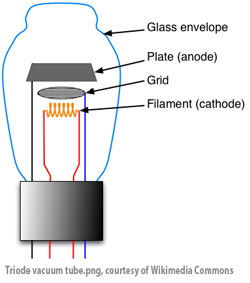
As the tube continues to heat, and as current through the tube rises, there is eventually a point where the negative grid restricts the rise of current. The tube finds a “balance” or quiescent point. You could say that the tube has found its “happy place” in this specific voltage environment with this specific cathode resistor value.
Now we apply a signal to the grid. Over the signal cycle, we can monitor the voltage between the cathode and ground. Instantaneously, the voltage might rise and fall with the signal. In a push-pull amp, this resistor might be shared by two tubes that alternately draw more and then draw less of the idle current. Over all, the cathode voltage averages to a value different than the idle value with no signal.
To counteract this effect, we add a capacitor across the bias resistor. This allows the signal-dependent current changes to be pulled around the resistor through the cap. We still find that the voltage across the resistor changes over the signal cycle, even with a very high value cap.
In cathode bias, then, we see that the bias condition of the tube changes with the signal. The idle condition is not constant. Hifi guys use a very large cap value but even this is imperfect. The usual 22uF found in guitar amps is not very effective at all, but it allows the tubes to transition to class-B to produce the rated output of the amp. See the Champ chapter of TUT3.
The idle condition can only change if the voltage between the grid and the cathode changes. The intuitive “fix” is then to remove the bias resistor and force the tube to conduct a specific current by applying the appropriate amount of negative voltage to the grid. We can still idle the tube at high currents if we want; this issue is discussed in the “class-A” Q/A elsewhere in this FAQ, and in the TUT-series.
With our negative control voltage applied to the grids, we find that the idle condition is more constant over the signal cycle. We then describe the idle condition as being “fixed” with respect to the signal. Colloquially, most techs and designers refer to the presence of negative grid control voltage as “fixed bias” or the related power supply as the “fixed-bias supply”.
We can achieve the fixed bias condition in other ways that do not require a negative voltage in the circuit, just as we can achieve class-A conditions without using cathode biasing. The use of the negative supply to control the tube is merely a bias method and should not be confused with the desired bias condition.
Q: I want to add meter test jacks to my amp, but all I can find are banana jacks. These are huge compared to the tips of the meter probes. Where can I get the right jacks?
A: All the major electronics vendors carry meter tip pin jacks. London Power’s BMK Bias Mod kits include the meter jacks, current sense resistors, bias pots and range resistor. There are versions of the kits for 2, 4, 6 and 8 output tubes. In the 4, 6 and 8 tube formats, the grid-leaks and extra coupling caps are also included. The kits are the BMK2, BMK4, BMK6 and BMK8 respectively.
Q: How can I tell if an amp is really class-A?
A: There is a lot of hype about “class-A”, a lot of misunderstanding about what it means, and a lot of misrepresentation of products claiming to be “class-A”.
First, we should understand what “class-A” means. There are several definitions as we saw in our books TUT1, TUT2, TUT3, TUT4 and POP:
1) All output devices continue to conduct during the audio cycle
2) Power consumption is constant from idle to full output
3) All output devices contribute to the audio signal at all times
4) Output distortion is predominantly even-order
The most important point to remember, is that class-A is a bias condition and it is referenced to the signal cycle.. This means that the tubes are running hot – often at their maximum plate dissipation – and it does not matter how we achieve this condition. “Cathode bias”, “self bias” (same as cathode bias) and “fixed bias” are all bias methods or specific circuit approaches used to get the tubes to idle at the desired current. These have been explained in detail in our books and many other texts.
It is obvious that a single-ended (SE) amp must operate class-A. It has only one output device, which must be conducting through the entire audio cycle if the entire signal is to be reproduced. This fits definitions 1 and 3. If we place an ammeter in series with the power supply, we find that power consumption rises at full output, so definition 2 is not met. The output distortion is mostly even-order, so definition 4 is met. In general, everyone agrees that an SE voltage amplifier and/or power amplifier operates class-A.
Push-pull class-A amps are most often cathode-biased, but many hi-fi amps are fixed-biased. The usual design approach is to idle the output stage at the limits of the tubes, and hope that this is slightly higher than maximum output required. Traditionally, this is achieved by idling the tubes at half the peak output current required for the desired output power.
We should look at a popular example…
Amps with quads of EL-84s are popular; the iconic AC-30 is their progenitor. The EL-84 is rated at 12W plate dissipation; four of them idle together at 48W. If we have the recommended (and typical) load of 4k-aa, then each half of the circuit “sees” a 1k-ohm load. 30Wrms is 60W peak, requiring about 245V peak at 245mA peak swing per circuit half.
According to the traditional approach, we should idle the output stage just above half the peak current, or about 130mA. Dividing this evenly over the four tubes means that each tube conducts 32.5mA, which at 12W means B+ could be 369V. Most AC-30s and copies operate at 320-345Vdc, and the idle current is a little higher. However, at the point where one side of the circuit conducts the whole 130mA or so, the other side is conducting zero current. This is a specific point known as “limiting class-A”. If we drive the tubes no harder, then we can still call this a class-A amplifier. But, we do drive the tubes harder to get to the 245mA peak we need for full output, and so we have gone out of class-A.
The power draw in our example rises at full output; this has been measured by many techs over many decades. When running such an amp into a bench load with a clean sine wave adjusted to just below clipping, it is obvious that the output stage runs cooler at full output than at idle. This is because the voltage across the tube is swinging between a low of about 55V to a high of about 565V. At the minimum voltage point, the tube is conducting the maximum current (245mA). At the maximum voltage point the tube is ‘off’, conducting zero current. If we take the average of the signal current (173mA) and multiply by the supply voltage, we have a maximum power consumption of about 60W, where idle was 48W.
Overall, the AC30 fails to meet the first three class-A definitions. Its distortion output is quite high and predominantly even-order, so on that basis only might we call it a class-A amplifier. Even here, there are two mechanisms that contribute to the THD that are not related to class-A-ness. The first is that the circuit is not dynamically balanced, partially due to the use of a cathode-bypass cap for the common bias resistor for the output stage. Dynamic balance is better without this cap, reducing both output power and distortion but then skewing the THD spectrum to a balance of odd and even harmonics.
Second, the high idle current causes a lot of thermal agitation within the tube, and thus generates a lot of thermal noise, which modulates the signal, creating intermodulation distortion (IM) that is far worse sonically than any THD.
To make a true, pure class-A amplifier, we must idle the output stage slightly above the peak current required. If we want the 245mA swing into the same 4k-aa load as above, our idle current should be at least 250mA. With a 320V supply, idle dissipation is 80W, or 40W for each half of the circuit. This would require eight EL-84s in total, or four of EL-34s, 6L6GB/Cs, or just two KT-88s. Since the peak audio current is less than the idle current, current pulled from the supply will be constant, and thus power consumption will be constant. The traditionally quoted efficiency for a push-pull class-A amp is achieved, at slightly less than 50%. Distortion will be low if signal balance is maintained, and the amp will be class-A by all definitions.
So, now that we’ve seen so many reasons for amps not living up to what they are said to be, how do we tell which are which?
The short answer is to look at the number of output tubes in the amp, and their types. Add up all of the plate power dissipations, and then divide this by two. The result is the theoretical maximum class-A audio power output, although the true value is slightly less due to the imperfection of tubes.
For example, looking at the AC30 again, we have four EL-84s rated at 12W each, thus 48W total. We could theoretically get 24W of class-A output from this tube set, which is about what was predicted in our book, TUT3 (The Ultimate Tone, Vol. 3).
Example 2: Suppose we have a pair of EL-34s, rated at 25W each thus 50W total. We would hope to get 25W class-A, but likely a bit less.
Example 3: Suppose we have four 6L6GCs (real ones), rated at 30W each. Therefore, we have 120W total and would hope for 60W class-A.
Example 4: Many newer boutique amps use a mix of tubes. Suppose we have a 6V6 working against an EL84 in push-pull. Both are rated for 12W, so the total is 24W, and the maximum class-A output would be 12W, or less.
Example 5: Further to example 4, suppose we have an EL-34 working in push-pull against two EL-34s. All the tubes are the same, but we have a dissimilar number for each side. Therefore, we use the lower of the power ratings for the two halves of the circuit, and divide that by two for maximum class-A. The circuit will produce more power than this (likely) but it will be asymmetrical and distorted, but will not be class-A.
It is an easy matter to achieve the sound of a class-A amplifier. It is much harder to find truth in advertising about just how class-A an amp really is.
Q: Some people suggest that in a cathode biased EL-84 amp, it is better to increase the bias resistor than to change the screen resistors if you want to extend tube life?
A: Proper screen-stop values guarantee life extension of the tube, and so does reducing idle heat.If you are going to change only one part of the circuit, the screen-stops are the first area to amend. EL84 amps tend to have low-value screen-stops and this is fine for hifi applications where clipping is to be avoided. However, when these circuits are used for guitar, clipping will be frequent and will damage the tubes unless they have increased screen-stop values as TUT described.
Taking care of the screen of the tube is especially important in cathode-biased amplifiers, as our book The Ultimate Tone, Vol. 2 (TUT2) details.
If you are already working inside the chassis, it is beneficial to change/add the screen-stops and increase the bias resistor values for cooler tube operation. Every cathode-biased guitar amp transitions from class-A to class-B before reaching its rated output. As TUT3 shows in its AC-30 chapter, splitting the cathode bias resistor allows further improvements in safety and adds versatility of use.
Q: Does the “70%” bias rule apply to cathode-biased amps?
A: No, that is a guideline used for biasing class-AB tube amps.
Cathode-biased amps are usually designed for maximum power in that mode, so the tubes idle at their full dissipation rating. This does not mean that idling them cooler is “against the rules”; in fact, it is a good thing, but will reduce the amount of class-A power the circuit delivers. In London Power’s STUDIO and KC-25 amplifiers, the cathode-bias mode is optimised for best distinction of tone rather than for power output.
Note that in push-pull amps, even though the tube is running as hot as it can to provide the most class-A output possible, the circuit transitions to class-B before the amp’s rated output is achieved.
Note also that the 70% guide, or even the 50% guide shown in TUT2 is completely arbitrary. We used 50% simply to get most tube samples into a “good” tonal range. As long as the tubes are ‘on’, which means just a few milliamps, they will produce a clean sine wave and have an acceptable tone. As idle current goes up, the tone will be warmer, too, but at some point there is no return for the extra heat.
Q: I just got my new London Power guitar amp and it… well… sounds crappy. What should I check? Or is it supposed to sound like this?
A: Prior to plugging in and playing, you have to bias the tubes. We set the bias pots back to minimum idle current before shipping, as this helps avoid certain problems during the first power-up after transit. The output tubes will be idling at a very low current if you turn the amp on without setting the bias the first time. The output will be low and dry sounding – not very musical at all.
The bias procedure is in the manual and is very simple to do. Once the tubes are biased up to a normal current, the amp’s tone opens up and will be very dynamic. You do not have to reset the bias until you change a tube, or if you merely wish to explore how the bias effects tone.
Follow-on: Wow! That’s all it took. The amp sounds as amazing as I expected it to when I ordered it. Thanks!
Note that as of 2014 we no longer hip the amps with power tubes, only with preamp tubes, as most players like to try variius tube options.
Q: I was biasing some tubes in my new Studio amp – great amp by the way! – and set the meter to milliamps by mistake. Will that damage anything? I noticed the manual said not to use a milliamp meter, just to use a volt meter.
A: No harm will come to the amp or your meter. The bias test points on all of London Power’s amplifier models are designed for use with a voltmeter of any type. Current-limiting resistances for the jacks themselves protect old-style galvanic meter movement volt-ohm-milliamp meters from potential damage if their range is not set correctly. This disallows the use of direct current measurement.
As the manuals for our amplifiers state: “The jacks are specifically designed for use with a volt meter and will give erroneous readings with an ammeter”.
Q: Is it really necessary to have separate bias adjustments for every tube? One adjustment is about all I can handle.
A: Individual adjusts give the greatest versatility for the amp user, allowing widely different samples of the same tube type to be operated together, or for different types altogether to be used.
The problem with the single adjust is primarily one of limited control. Even a matched tube set will go out of match during use. Unmatched tubes will behave however they behave, and you will need individual monitoring for each to at least know if each is operating safely. The mismatched set will probably sound better than the matched set, since some asymmetry is required to achieve the “best” or “traditional” sound.
So, single bias adjusts are not exactly “evil”, but they compromise your control of the amp and disrespect the amp owner.
If you have an amp with a 4-tube or more output stage, it is good to have at least two bias pots, one for the ‘push’ side and one for the ‘pull’ side. This allows proper hum-balancing of the output stage. Set the first side by meter to assure a safe idle condition; then set the second side by ear for minimum hum. In this scenario, you will not know how each side is sharing that current, so it is best to settle on the lowest current that sounds good, and to watch the tube plates to make sure none are red-plating.
Q: How important is it to adjust the bias if I want to put 6L6s into my Marshall?
A: Tube suppliers make many statements to protect themselves from liability when such substitutions are attempted. If the amp is working properly, then 6L6GCs can be used in any Marshall. The 6L6-types will run cooler but still provide full output power, and power transformer life expectancy will be extended because the heater current is lower with these tubes compared to EL-34 and 6550.
BIAS SWITCHING
Q: How can I switch between fixed-bias operation – how my amp is wired now – to cathode-bias operation? I would like to hear the difference, so it would be cool to have it on a switch.
A: “ANYTHING is possible in the land of mods!” Click here for an excerpt from The Ultimate Tone – Volume 2, which explains how to implement this option.
CIRCUIT DESIGN
Q: Are there any new tube amp circuits? One amp builder claims they do not copy or clone anything. Seems hard to imagine.
A: The basic circuits for pure tube preamps and power amps have not changed in many decades. If you look at modern guitar amp schematics, you will see odd values sometimes, but the circuits will resemble those of older amps. It is only in the area of hybrid technology tube circuits where you find new ideas, such as with Z-B-X and ZBX-2, or with David Berning’s and Lars Lundahl’s resonant transformer output circuits (from the 2000s and the 1960s respectively).
Everyone building amps – or any other product – thinks they are doing something new and incredible. For the individual, the mere fact they could assemble it and have if work IS new and incredible! In the bigger picture, we see most people re-inventing the wheel. But … in an even bigger picture we see that we each individually create our own whole universes, including our own interpretations of other people in our universe, who have created their own universe with an interpretation of us in theirs. So, there are lots of things that are newly created, but the patterns for these items were set a long time ago by others.
Q: Badcat amps has just released their “K-master” master volume. Is this actually new technology?
A: Not at all. The description of the circuit suggests that there is gain after the splitter, which has been done since the beginning of tube electronics. Think of this as a standard preamp followed by a standard MV, then the splitter for the push-pull power amp followed by more gain, then the power tubes and output transformer. The extra gain in the PA is controlled by the “k-MV”. You can run the preamp clean or distorted independent of running the power amp clean or distorted.
There are quite a few misleading and outright incorrect statements in John Gilmour’s (owner of Badcat) post on TheGearPage. They do not reflect the mind of someone who knows how to design tube amps. The post is reprinted here in italics, with our comments in between:
“The K Master IS confusing. It is so new and different. It confused ME when I first saw the circuit. George Klimek (The K in K master) came up with the idea. What it does is, separate the pre amp from the power amp. There is a circuit between the phase inverter and the power output. So think of the preamp as nothing more than how much grit or distortion you want.”
This just describes as above, gain between the splitter and output stage as used in many hifi designs and Marshall’s rack-mount 50+50W tube PA. Three gains stages within a feedback loop tends to be unstable.
“Ordinarily the output from the preamp dictates how much voltage goes to the power tubes after the phase inverter. A regular master is a pot that sits after the phase inverter …”
He is describing a post-phase-inverter MV (PPI-MV), not a standard MV that precedes the splitter.
“…and takes your signal to ground. It should actually be called a master attenuator. We have placed a controllable voltage output to the power tubes ( The K master) that can be pushed to full output potential even with very minimal output from the preamp. With even a small (very clean) preamp output the power tubes can be pushed into clipping.”
Again, just describing the fact that there is gain after the splitter.
“Let me illustrate,
On a normal master volume when you want to see how much clean headroom you can get you put the master wide open and use the preamp to push up the amp volume. That is the full output of clean headroom you have available.”
So far, correct.
“In the same scenario with the K master you set the preamp how you want it to sound and drive up the power tubes to their full potential , which is well beyond how loud the amp would be with what signal is coming from the preamp. Think of it as signal booster after the phase inverter prior to the power tubes.”
This is inaccurate. Since the k-MV is the last control in the signal chain that determines overall loudness, it is simply a MV – it makes no difference if it is passive or active. To experience the clean output of the amp, you can set k-MV to max then slowly increase the preamp volume until clipping occurs. Clipping will occur first at the output stage, just as with a Fender amp, a plexi, a Hiwatt, or most other amps. There is also an assumption of a low-gain preamp, such as is found in the Route-66 (Dr.Z) , or as found in many of the limited tube count 18W amps. Those amps, as designed originally by the big OEMs, were intended as “tuning” or “practice” amps – not for “real” performance or stage amps. Real amps designed for real players have more gain in the preamp.
“It also eliminates phase cancellation that is experienced in a normal master volume. Which is why you lose bottom end and gain.”
Phase cancellation only applies to cross-line MVs, but is not the reason for tone change over control sweep with this MV wiring. As with a standard MV, the reduced resistance at low MV settings changes the RC time constant as the control works against the circuit capacitance. TUT showed the fix for this, as it applies to standard MVs. For a cross-line MV, see the Soma-84 project in TUT5.
The reference to a regular MV being after the splitter assumes that there is no feedback loop around the power amp. In the low tube count 15-18W amps, the gain that must be sacrificed to have a feedback loop around the power amp would make the amp much less useful. Look at the Fender Champ as an example of too-little gain because feedback was incorporated. The “loopless” copies such as the ValveJr still have too little gain, which modern amps like the Marshall C5 address by adding an extra preamp stage. Similar mods should be made to the 15-18W amps and the k-MV is an attempt to do this. The extra gain is added after the EQ though and whether it is placed before or after the splitter is irrelevant to the result.
“You will hear your exact full tone all the way down to whisper quiet.”
Any properly designed MV will do this over the clean range of the amp.
In another post on the same thread, John states:
“most 15 watt amps will not give you continuous 15 watts of clean headroom”
That would have been a good place to differentiate his products – they must not meet their power rating either. In conventional circles, power output is clean sinewave power. Peavey rates their amps at 10% THD, which shows visual flattening of the peaks but nothing extreme.
Further along, John says:
“As for whether this is unique or not, we will let the patent office decide that.”
John, the patent office does not care about “originality”. They will take your money regardless of whether the idea is public domain or not – which it is. Many companies play the patent-pouch game to have bragging rights that they have this many patents, or more patents than so-an-so. Better to stroke your ego with huge sales rather than making your attorney and the USPTO rich.
Q: A friend of mine builds hi-fi amps and suggested using an 845 for guitar. Is that crazy?
A: The 845 power triode, and similar tubes such as the 211, 811A, 812A, 572B, 300B and 2A3 are touted by some audiophiles as having the best tone for audio. They are quite linear tubes often used in single-ended circuits at high-voltage creating just a few or tens of watts. The 211 used in push-pull easily produces 200W+ as a pair. Similarly, the 811A can produce up to 340W per pair at 1500Va. These tubes do sound quite warm and transparent.
Most applications using the 845 et al have a plate supply of 800V. This is pretty dangerous for hobbyists to tinker with BUT you can use these tubes at more typical guitar amp values and still appreciate their tonal offerings.
Any tube that can amplify can be used in a guitar amp circuit. For guitar, “best linearity” is not a prerequisite. So, this opens the door to all kinds of experimenting and opportunity to create something especially pleasing.
Q: An amp builder is claiming that operating tubes at low voltage and high current will make the tubes last longer. Is this true? And if it is true why doesn’t everyone else do this?
A: No, that is not true. In fact, it is exactly opposite to the truth.
Tubes can withstand voltage stress for their entire life and do not lose this ability unless the glass seal is compromised. At that point, the tube won’t function anyway. Tube manufacturers consider a tube to have reached the end of its useful life when the cathode current emission drops to 50% of the rating. This is a true measure of the tube’s capability.
The tube manufacturer’s own recommendation will always be to allow high voltage within the ratings, and to keep currents low to extend cathode life. This is exactly what we see in old amps and modern amps alike, except in cathode-biased amps where current and heat are maximised – both of which erode tube life.
The only way to extend tube life by lowering voltage is to also reduce current at the same time. This reduces heat from the tube. Of course, this is exactly what happens in a Power Scaled amp, and tone is retained.
Q: I want to build an amp but can’t figure out how to match up the proper power transformer to my output transformer. Is there an easy way?
A: Yes, two of them. The first is presented in our Hammond pages, which list the traditional specs for their line of output (OT) and power (PT) transformers. We have added a lot of extra information about each unit to emphasize the power requirements of the output transformers and the capabilities of the power transformers. To make things even simpler, there is a list of which PT works best with each OT. This information is further expanded upon in our book, The Ultimate Tone, Vol. 5 (TUT5).
The other way to figure out the OT/PT match is to use the advice given in TUT3 about sizing power transformers, combined with the design information in TUT2 for output stages.
Q: I see your new amps use electrolytic capacitors. In your books you say those are not as good as plastic filter caps, so are your amps as good as they used to be?
A: Careful reading will show that there are performance differences between electrolytic and plastic caps, but there are very good examples of both. The longevity and near perfect performance of plastic caps is often outweighed by their bulk and cost. Modern electrolytics are very good quality, and surprisingly, it is not the most expensive samples that perform best.
We wanted to make our new amp line affordable to more players, and electrolytics were a step in that direction. The amps use a mix of brute-force filtering followed by a sophisticated active hum filtering circuit. High-quality components and proper circuit layout and design give the new amp line a level of performance that was not possible in the past. For a low-wattage amp, an all-plastic supply is still affordable and performs very well. Over the years, London Power has used all-plastic supplies, all-electrolytic, and hybrid supplies, always achieving the same performance.
Q: I want to build a monster bass amp with tubes. The 400W amps from Marshall, Trace Elliot and Fender all use eight power tubes. Is it just a “given” that you only get 100W per pair of tubes? So, a 500W amp would need ten tubes and 600W would need 12 tubes and so on?
A: The examples all use the tubes conservatively. In each case, 6550s or KT88s are used, both of which will yield 140-150W per pair. In the 1980s, Fender built their PS-series amps with a 300W model using 4×6550, and 435W model using 6×6550. The tubes are within their safe operating limits in every case.
Part of the limitation or seeming lack of imagination in the 400W-class is the need to use commonly available tubes and relatively safe voltages. A single pair of 811As ($20 each) can produce 340W, so a quad could easily do 650W. The downside is that this requires a 1,500V supply. A single pair of 572Bs ($60 each) can produce over 800W on a 2,700V supply. These voltages require chassis interlocks to protect service people and the end user from electrocution – these are lethal voltages! – but common sense and good mechanical design minimize this risk.
The low tube cost compared to a sea of 6550s is very attractive. The high-voltage supply is not necessarily more expensive to build, and neither is the output transformer more expensive for this kind of amp vs. one running at lower voltage at the same power. There is a detailed discussion of this topic in our book The Ultimate Tone, Vol. 4 (TUT4), as it pertains to design decisions at all power levels.
Q: Why didn’t you include load-lines in The Ultimate Tone?
A: The Ultimate Tone (TUT1) is aimed at the average tech or hobbyist who wants to have a reasonable, succinct explanation of how things work and what their options might be. These readers typically want some math, but are not interested in designing things, rather just changing things. The methods and examples shown in TUT are based on real-life practice and applied theory and allow the reader to confidently modify or build the project at hand.
TUT2 goes deeper into the design of tube and solid-state power amps and does include load-lines. TUTs 5&6 take things a step further.
EFFECTS LOOPS
Q: I want to have an effects loop in my amp but I’m confused about series loops, mixing loops, parallel loops, instrument level, line level and guitar level. What do all these things mean, and how can I get a really good loop for my amp?
A: That’s actually two questions.
Regarding all of the terms, these are explained in detail in our book The Ultimate Tone (TUT1) and also in our document on this website, “Effects Loop Truths“. Essentially, series loops place the effects in series with the whole signal somewhere in the signal chain. Parallel and mixing loops are the same thing, where the signal splits between the effects and a “dry” non-effected sound, with both paths mixed together.
Guitar level and instrument level mean the same thing. This is the signal level you get directly from the guitar, and is about one-tenth of a volt. A line level is what is required to drive the power amp to full output and is typically one or two volts. It is also the level from a preamp output, naturally, as the preamp is what drives the power amp.
As far as having a loop in your amp that can handle a wide range of signal levels, our Best All-Tube Effects Loop Kit (BFX) does it transparently while giving switchable series/parallel operation. Yes, you are adding a tube to your amp – which we assume has tubes already – but the BFX will not change the basic sound. It has separate ‘send’ and ‘return’ controls for the best optimisation of signal strength through the effects. Loops without these controls are just a compromise.
KIT QUESTIONS: GENERAL
Q: You used to offer a switching kit using PVAs. Why did you discontinue it?
A: Photovoltaic relays, or PVA-series devices from International Rectifier, and built by other manufacturers, are very neat devices. They conduct current bilaterally, so they can handle AC signals. They offer very high signal voltage handling possibilities. The control side is basically an LED, so it is quite easy to drive. With optical coupling between the LED and the bilateral switch, the voltage difference between the control circuit and signal path can be hundreds of volts.
It seems like an ideal alternative to relays. But… it has one big flaw: variable switch capacitance that depends on the voltage across the switch.
When the PVA is ‘off’, there is capacitance between the two ends of the switch. This capacitance rises as the voltage across the switch is reduced. It is good practice in audio circuits to provide a DC path to ground on either side of an audio switch – particularly series switches – to reduce DC shifts in the circuit when the switch opens and closes, which comes through as nasty pops. Unfortunately with the PVA, this is the worst voltage condition for it to be in, as its capacitance is the highest – 100s of pFs – so there will be high-frequency feedthrough. This will at best be merely annoying, but at worst can cause circuit oscillations.
In low-impedance circuits, this capacitance might not be a problem. In the high-impedance tube circuits of guitar and hi-fi amps, the PVA cannot be used in the usual way. It can be used where there is a standing DC voltage in the off-condition for the switch AND where its switching function will not cause an audible glitch at opening and closing.
In guitar amps, the places you might think to use a PVA are better controlled using miniature relays. Relay quality has improved in recent times.
Q: The LP-MV (London Power Master Volume) kit seems like a very simple solution to controlling volume without tone change. Will I still be able to use my ‘presence’ and ‘resonance’ controls?
A: Yes. Their function as power-amplifier feedback frequency shapers is unchanged. However, the depth of effect must be kept proportional to the signal size, and the LP-MV takes care of this automatically.
There is a trend away from power-amp ‘presence’ controls to preamp ‘presence’ controls. This simplifies wiring and board layouts within the amp. The presence effect is achieved in a different way, but it is difficult – if at all possible – to hear a difference.
KIT APPLICATIONS
Q: Can I use the GMX kit as a power amp? If I drive it from a 12AX7 will it sound like a real tube amp?
A: Note that GMX is a discontinued kit. Yes, you can use the GMX (Transconductance Multiplier) kit as the complete output stage, or merely to augment the tone and/or power of a conventional output stage. There are a few things to consider.
Assuming you wire the 12AX7 as if it were two triodes driving the output transformer (OT), the sound will be that of a triode amplifier: clean, transparent, and very linear. The GMX circuit will just make this sound even larger and more transparent. In this arrangement, the plate supply must be kept within what a 12AX7 can handle, so something less than 300V – the rating used in datasheets assumes a transformer load – in turn requiring the use of a custom OT. This will accommodate the OT flyback voltage. Note that the current sample and sense resistors would have to be significantly altered in proportion to keep the current through the tube within its limits.
If you were looking at a more “modern” application, the 12AX7 becomes a gain stage and a concertina splitter, or is wired as a Schmitt splitter, with the split outputs driving the GMX inputs. In this case, the current sample resistors are removed and the mosfet current-sense resistors increased in value.
In any application, the GMX circuitry requires appropriate heat sinking.
KIT ASSEMBLY
Q: I assembled one of your kits but noticed later that I was supposed to leave the 1W resistors up off the board. Do I need to get new resistors and mount them like the kit note says? Will the kit still work if I don’t?
A: Power resistors are used in circuit locations where the product of the voltage across the part multiplied by the current through the part will cause some heat to be generated. A resistor rated for 1W is physically larger than one rated for 500mW, so the 1W part can radiate more heat if required, or radiate the same amount of heat with a lower temperature rise.
The best way to get this heat away from the part is to allow for airflow around the part. This is easily achieved by not pushing the body of the resistor all the way down to the board. Instead, the leads are left a bit longer so there is 6mm or so (about 1/4″) between the board and the resistor body. Apart from providing better cooling for the resistor, elevating the part will keep it from burning the printed circuit board if it gets very hot.
Ohm’s Law will tell you how much current will pass through the resistor for a given voltage across the resistor. However, in most cases, you can calculate a “worst-case” heat level by making simple approximation. Most power resistors used in our kits are across the supply rail – that is, one end ties to the supply and the other is at ground, or very nearly so. In such a case, you can simply use one of the power equations (See our book Ready Set Go) and take the square of the supply voltage divided by the resistance.
(V x V) / R
If there are resistors in series, they share the voltage in proportion to their resistance values, and thus the power is shared as well. Notice where this occurs in the given circuit to save yourself from having a “too worst-case” approximation that is exaggerated.
So, you have to figure out how much heat the parts will dissipate to determine how “risky” it might be to leave them flat on the board. The circuit will no doubt function well for years without any changes to how these parts are mounted.
LICENSING
Q: If I want to build amps using ideas from your books, do you have a problem with that? Will you sue me?
A: Our books have inspired many hobbyists to become amp builders. Most are honourable people who work hard and give proper acknowledgment as to where “their” ideas came from. A few have been secretive about using our designs, and likely behaved that way because the USA is so litigation crazy. There are stories of innocent inquiries such as yours being jumped on by a company’s full legal department. That’s no way to reward integrity. 
Obviously, you can build anything you want from any book for yourself. Once you are selling those constructions, however, you have “commercialized” something that was not yours to sell. However, if you are approaching such a milestone in your own business development, just buy a licence LIC from our site for each chassis you sell that embodies our circuit ideas. If you actually use one of our kits in your amp, then that kit installation is inherently licensed and you do not have to buy LIC for that chassis. if you later copy the kit in further units of your own, then you would buy LIC for those subsequent units.
If everyone just did the right thing, and could count on a right response, then the world would be a much friendlier place.
LONDON POWER AMPS & GEAR
Q: Your new amp line looks really cool. What happened to the Zen and the Mini-Marshmallow?
A: The Mini-Marshmallow preamp has been deleted, and the Zen, Swede and London Power Standard sounds are offered by the SUPER STANDARD. The preamp include a full effects loop, two main outputs and a DI, plus very flexible front-panel and remote-control options. The Dumble tones of the Mini-Marshmallow are found in our D-PREreamp kit.
For DIYers, the circuit essentials have become available as preamp kits. TUT6 outlines some Mini-Marshmallow options in its Dumble chapter, while the High Gain Preamps chapter details circuits that will provide the Zen experience.
Q: Are any of the new amps in your line hand wired?
A: Yes, but not in the colloquial sense. They are all built on high-quality printed circuit boards, which are hand stuffed and hand soldered, then hand wired to each other. For reliability, our PCBs have heavier copper traces than the industry standard. Serviceability is greatly improved over hard-wired models from the past – and particularly compared to mass-produced PCB amps – because of thoughtful physical layout. PCB construction allows circuit refinements that would be a nightmare to wire by hand even for your personal amp, so overall performance is silky smooth.
Hand-wired amps can take days to wire given a free schedule, but that often expands out to weeks or months when trying to handle day-to-day business activities. Printed circuit boards change all of that. PCB assembly allows amps to be final-assembled in a short lead time from pre-assembled modules, improving product throughput.
MODIFICATION PLATFORMS
Q: Are the re-issue Fender Twin Reverb amps good platforms for mods?
A: Not really, especially if you want to tinker frequently. These amps are built on PCBs in a fashion that does not allow cleaning of the pots, let alone quick re-wirings or parts swapping.
If you are considering an extensive modification, i.e., channel switching and a total gain restructuring, the amp may be viable. In this case, you could lose the PCBs and rewire with home-made eyelet boards. Unless you are getting a fabulous deal on this amp, it might be wiser to pick up a silver-face Twin. These were better built.
Q: What are the best amps to use as a basis for a custom build?
A: A custom build would ideally be entirely custom with a blank chassis and new transformers. But… if you really want to start with an OEM amplifier, then old Traynor amps are excellent, particularly the larger Bassmaster YBA-1A rated at 80W. These amps have a 10″ deep chassis (front-to-rear), 2″ tall and 17″ wide – a good size if you want to rack mount it or just have it as a head. The Hammond transformers are based on standard types and are pretty rugged. The ridiculous bargains of the past are gone, but these still sell at lower prices than the parts are worth.
If you want to begin with a combo amp, Traynor’s YGL was made as their copy of a Fender Twin reverb. This is a spacious chassis, usually with good iron. Otherwise, an old Fender twin Reverb Pro Reverb or Showman Reverb would be a good choice. Again, lots of space (not as much as in a Traynor), lots of tube positions and control positions.
The projects in our book The Ultimate Tone, Vol. 3 (TUT3) are also fantastic modification platforms. They use Hammond chassis and transformers and have excellent note articulation combined with low-noise performance. Adding preamp channels, effects loops, and Power Scaling are all straightforward.
NOISE, HUM, CRACKLE, BUZZ
Q: Is there a way to reduce the noise in my [Peavey] 5150’s high gain channel without having to use a noise gate in the FX loop? My [Mesa] Triple Rectifier is pretty noisy, too.
A: Yes. The Rectifier models and the 5150 are copies of the SLO from a Soldano (poor Mike never gets proper credit!) and they all have masses of raw gain. So much, in fact, that you can easily lose some and not miss it.
The amps ship with 12AX7s, which are the high-mu members in their family of tubes. The 12AT7 has a slightly lower mu of 70; the 12AY7 is at 50 and the 12AU7 has a mu of just 20. All of these are pin-compatible, which means you can pull out a 12AX7 and plug in any of the others. As you go to lower-mu tubes, the noise diminishes very quickly. You might worry that too much gain will be lost at the same time, but the voicing of the preamps of these amp models is such that you always have a “gainy” sound.
Remember, each tube has two sections, so two gain stages are being shifted to the new raw gain value. On the other hand, because the stages are cascaded, their gains multiply. For example, two 12AX7s making up a four stage preamp have a theoretical raw gain of 100x100x100x100 or 100 million. If you replace one 12AX7 with a 12AU7, then the theoretical raw gain is reduced to 100x100x20x20 or 4 million. That’s a 20-times difference, which in itself seems dramatic, but it is still 1,000 to 10,000 times more gain than it takes to have fully saturated distortion tones.
The real gain exhibited by real tubes in real circuits is far less than the theoretical values. Heavy attenuation and frequency shaping between the stages “throws away” much of that gain, and what makes an amp sound and feel gainy is just that frequency emphasis or voicing.
Q: I have a VHT stereo power amp. One channel was making a crackling sound, so I looked inside and noticed that one power tube was glowing orange. I replaced it and the new tube glowed orange, too, but it was the non-glowing tube that was causing the crackling. When I replaced that tube, the tube that was glowing orange wasn’t glowing orange anymore. How can the one tube affect the other? I had the amp set to ‘class-A’. Everything worked and sounded okay once I replaced the crackly tube.
A: The key is that you were in the ‘class-A’ setting for the amp.
As in most amps, any reference to “class-A” is truly saying “cathode bias”. Also like most amps, the cathode-bias resistor is shared by both tubes in the output stage and is sized accordingly. If one tube is missing or not conducting its share of current, the other tube will bias to a point that is above its plate dissipation rating, and the plate will glow orange.
The crackling tube in your amp must have had an intermittent internal connection to either the cathode, screen or plate. Interrupting the primary current path from the cathode to plate takes that tube out of the circuit. It does not conduct any current and is basically ‘off’.
An intermittent screen connection causes the tube’s internal resistance to rise significantly when the screen voltage disappears. Again, that turns the tube ‘off’. The intermittence of this connection will be heard as crackling through the speaker. A faulty screen resistor can cause the same symptom, and sometimes the symptom does not occur until the amp warms up.
In the ‘class-AB’ mode of this amp, the tubes are operating with a fixed bias voltage and therefore idle independently of each other. If the crackling tube opens and conducts zero current, it has no effect on the other tube. You might hear crackling and possibly a small increase in hum until the tube reconnects itself.
Q: My amp hums while it is warming up but the hum goes away after a minute or so. Should I replace my power tubes or is there something else wrong with the amp?
A: If the amp is quiet after it warms up and the sound it produces is as it should be, then there is nothing wrong with the amp or its tubes. Tubes may warm up unevenly in a push-pull circuit, so during that period, there can be a DC imbalance in the output stage. This allows the hum on the supply to appear on the speaker output. Once the tubes are up to operating temperature, the circuit achieves DC balance and the hum is “balanced out”.
Q: My rectifier tube rattles even when I’m not playing. I’ve tried a different one but it does the same thing. What should I do?
A: The rectifier tube is typically placed right next to the power transformer. This keeps the internal wiring short and neat. However, the mechanical vibration of the transformer upsets the rectifier tube. This is partly because most rectifier tubes have only 4 or 5 pins on their base. With up to half of the octal positions empty, these few pins, plus the key pin in the middle, must support the tube. Re-tensioning the tube socket is your first line of attack. However, the sockets float in the octal housing, so the tube can still rattle. The next step is to add a spring retainer and eliminate the base lock ring. A thin rubber pad in the cup of the spring retainer will help damp any remaining vibration. Now, you are at the mercy of the quality of the tube.
PILOT LAMP
Q: My Fender amp has a red power lamp. I’ve heard that you can get other colours. Are they expensive to replace or do I have to order them from Fender?
A: The old style Dialight lamp holder has a coloured glass jewel lens that unscrews from the front for easy lamp replacement. The bulb itself is a push-and-twist bayonet base #47 bulb – an industry standard. Dialight make red, green, amber, blue, white and clear glass jewels, and red plastic jewels that are a different shape (stovepipe or fluted).
These are available from any Dialight distributor.
PLAYING BASS THROUGH GUITAR AMP
Q: Is there any problem using a guitar amp for bass?
A: No, as long as nothing is being damaged, whatever gets you your tone is okay. Be careful, though, with combo amps, as the speaker is more easily damaged by the low notes on a bass at high volumes.
POWER SCALING
Q: I read about the Power Scale-TT technology. Isn’t this what some other amp builders do?
A: Power Scale-TT is essentially Two-Thirds Power Scaling, which we call PS-TT. PS-TT is the type of circuit used by designers who do not want to tackle managing the heat from the regulator in a fully Power Scaled amp. Part of their decision is economic, and they almost universally make related choices that alter the amp tone even at full output compared to a fixed-power tube amp.
True or “full” Power Scaling, we term “Full-PS“. As our tech articles state, Full-PS provides maximum tube life extension with the most accurate tone from full power down to a whisper. The heat pouring off the Power Scale regulator is heat that would otherwise be handled by the tube. A hot regulator means the tube is colder and will last much longer. PS-TT extends tube life too, but not as much. The amount of heat handled by the regulator is lower, so finding a place for it on the chassis is easier.
London Power set the standard for Power Scaling methods and results, and those who copy it sometimes do it poorly. They change aspects of the circuits thinking the changes do not matter and hope it otherwise makes their “version” look more original. In doing so, the dynamic performance of the amplifier may be compromised. Using genuine London Power circuits, kits and methods as outlined in The Ultimate Tone book series provides full amplifier performance for both Full-PS and PS-TT approaches.
See also: Power Scaling FAQ
Q: The notes with the new Power Scale kits show two ways to wire it. How do I choose which to follow?
A: Sonically, both wirings will achieve the same result of truthful cranked tone at low-SPLs. The main difference will be in the amount of heat handled by the Power Scale circuit. The Full-PS wiring runs hotter over part of the Power Scale pot sweep, but extends tube life by decades. If there is no room for a fan or heatsink, and the amp is cathode biased, or the amp is very high power, the PS-TT wiring may be better to try first.
Q: Is it true that the SV-TT Power Scale kit can be used in every amp made?
A: SV-TT has been discontinued. Yes. SV-TT (SV-TT Super Versatile Two-Thirds Power Scale Kit) can be used in nearly 100% of production tube guitar and bass amps. It would be a clean sweep of 100% were it not for the 650W bass amp built a few years ago using 812A output tubes. These operate at 1500V, nearly twice the 800V rating for the SV-TT.
The SV-TT can be used with fixed-biased amps, cathode-biased amps, amps with up to 800V plate and/or screen voltage, and/or amps up to 700W using no more than the chassis as a heatsink.
Note that SV-TT is optimised for high voltages. Some tweaking may be required for supplies under 500V, where in reality the SV1 or SV84 + TBS (Tracking Bias Supply) would work better and be smaller fitments.
Q: A while back I Power Scaled my Fender Twin Reverb amp using the SB-1 kit. It works really great! Recently I tried adding one of the Sustain kits, the SUS-3, but can’t get any compression. What should I look at to get it working?
A: Note that this answer also applies for modern installations using SV1. SB-1 was discontinued in 2012.
Within the SUS kit itself, there are a few resistors that can be tweaked to change the attack, release and depth of effect. Keep in mind that the Sustain effect is SUBTLE as it only changes the attack of notes, rounding them to be less abrupt. R21 changes the basic depth of the effect, but R17 and R18 also contribute to raw depth.
However, the first thing to check is the raw bias voltage being fed to the SB-1. If you are just using the bias tap on the power transformer, odds are that the raw bias voltage is not high enough to provide the best performance from either the SB-1 or the SUS-3. Measure the raw bias voltage at W3-5 on the SB-1, then the voltage fed to the bias pot from W3-4. If these are very similar, the bias regulator operation is marginal at best and the SUS will provide no effect at all near full power.
To fix the bias voltage issue, an alternative raw bias supply should be installed. The RBX Raw Bias Auxiliary Supply kit is designed for situations just like this one.
Q: I added the GMX kit to my amp and it really did make it sound bigger. Cool! I’m trying to add Power Scaling now but there seems to be some interaction with the GMX circuit. The GMX makes the sound bigger while Power Scaling makes the sound smaller, so are they sort of battling each other? The amp makes funny noises when I dial it down.
A: Note that the GMX is a discontinued kit. The problem here is that you are Scaling the supply to the GMX control circuit. That circuitry needs a fixed supply. Move the “B+” connection for the GMX card to the Va or Vs filter cap directly. Assuming you are using a DC Power Scaling kit such as the SB or SF series, the centre-tap of the output transformer will be Scaled but not the feed to the GMX board. The other GMX circuit connections remain as for a fixed-power amplifier, and the GMX will track the changes to the Power Scaled output stage.
Q: I’m trying to figure out how to Power Scale my Blackheart amp using the SB-2. The screen voltage is about 50V less than the plate voltage, so which one should I use for the Power Scale pot?
A: Most EL-84 output stages, including the Mesa F-30, the Valve Juniors, and all of the copies like the Blackheart, have significantly lower voltages on the screen than on the plate. The standard wiring for the SB-2 will cause a reduced maximum output power but will go down to unusably quiet levels.
The alternative wiring for the PS pot will introduce a dead-spot in the control sweep, where the top end portion does not vary output, although this allows full output to be achieved and unusably quiet output when dialled down.
The fix requires three steps: First, power the PS pot from the Va node. Second, control the Vs regulator using a voltage divider tied to the Va regulator output. Use 1k/V for the divider – often resulting in a 330k-1W to ground and 33k-68k between regulators. Third, add a 10k series resistor between the PS pot ‘X’ and the Va cap positive. Then add a 22uF-450V cap to ground from the PS pot ‘X’. This will provide a cleaner voltage to the Power scale pot, which in turn feeds a cleaner voltage to the regulator gates.
The divider fix maintains the stock proportion of screen and plate voltages over the full range of full-power down to unusably quiet.
In these lower-voltage amps, one could also use a 24mm ganged pot for the regulators. The pot should be rated for 500Vdc. This application of direct control is not universally applicable, as our book TUT4 (The Ultimate Tone, Vol. 4) discusses. The Drive Compensation function should be left on a separate control and not ganged with the Power Scale function.
Note that SB-2 is a discontinued kit, replaced by SV2. SV2 allows for differences between the screen and plate voltages and there are no “dead spot” issues.
Q: Can I get the bias voltage to remain on the tubes when my Power Scaled amp is on standby?
A: Standby (SB) switches are not really needed on guitar amps, but your question brings up a few things to consider.
If the standby disconnects the plate supply, then Va and Vs both fall to zero and -Vb will too. In the absence of plate or screen voltage the tube will not conduct any current, which means that the presence or absence of grid voltage is immaterial. Aesthetically, you may prefer -Vb to remain in standby.
See our Technical Article regarding standby switches.
Q: I installed one of the old Power Scale Kits and have another amp I wish to Power Scale. Should I use the old PSK circuit or one the new DC Power Scale Kits? Is there an advantage to the old ones?
A: Since you installed the old style circuit, you already have some experience with it and would have an easier time installing Power Scaling a second time than a first-time tech would. On the other hand, the new SV-series Power Scaling kits are simpler to install and use a smaller pot.
The Power Scale control itself can be located anywhere on the chassis as it carries filtered DC and therefore cannot interfere with any audio signals. DC-Power Scaling is better suited to multi-channel amps than the old-style PSKs are. This is especially true if multiple PS controls are desired, or when Power Scaling is to be used only with one preamp channel. Power transitions are instantaneous with the SVs, whereas the older design required a fast-transition circuit to get a “reasonable” but not-as-quick transition.
The old-style PSK-1 for fixed-bias amps and PSK-2 for cathode-biased amps operate with pulsating DC, which is very noisy. Wiring layout and component placement is trickier, and can highlight faults already existing in the amp’s wiring. This takes a very talented tech to install, and our list of recommended PS-installers have a lot of experience and creativity. The old-style PSKs work well for single-channel amps. The new style SV1 is for fixed bias amps, and the SV2 is for cathode bias. Small amps can use the SV84 on its own if the amp is cathode-biased, or add TBS (Tracking Bias Supply) if it is fixed-biased.
Note that most amps have barely adequate bias supplies even for their stock function, and are entirely inadequate to support the Power Scale kits. Add RBX in most fixed-bias installations. See the guides “Selecting a Power Scale Kit” and “When is RBX Required” to determine if you need RBX or not.
Q: I have a high-voltage Marshall that now is Power Scaled with a PSK-1. The B+ regulator gets pretty toasty sometimes. Can I fix this without adding a fan or big heatsink?
A: You cannot change the amount of waste heat, but that heat can be shared between two devices so each runs a little cooler. Our book The Ultimate Tone, Vol. 4 (TUT4) illustrates how to make a Power Scale Cascode.
In all cases, getting rid of the heat faster improves reliability. A 12Vdc fan operating at 8Vdc derived from the heater will be quiet and move enough air to make a significant improvement in safety. Adding a small heat sink can assist in the heat transfer.
POWER SCALE SWITCHING
Q: I added one of your Power Scaling Kits to my amp and it works great! Now I want to modify the preamp for two channels. Can I wire up a second Power Scale control so each channel has its own power amp setting?
A: Yes, switching between them using a relay. Remember to add a second Drive Compensation control and switch that with the relay also. For the classic-PSKs, a fast transition circuit is also required (outlined in our book The Ultimate Tone, Vol. 4 – TUT4) to make the transition from one power level to the other quick enough to be useful live. However, it is still not really fast enough for fast changes, so better to use the newer circuit forms.
You could also convert the circuit to the new DC format, detailed in TUT6.
With the modern SV-style Power Scaling kits, the Power Scale control can be switched using a relay and power transitions are fast up and down.
Q: If I want to go just from a Power Scale controlled output level to full output, can I just add a footswitch or relay?
A: For our older, classic PSK Power Scaling Kits, that would not perform the task properly. As for the situation in the question above, a fast-transition circuit is required. See TUT4.
If you have one of our older “SB” Super-Budget kits, then lifting the PS pot will achieve the function you desire, but there may be a loud pop. You can minimize this with a cap across the switch.
With SV “Super Versatile” line of Power Scaling Kits marked as SV-CF, simply lift the wiper of the Power Scale pot to go to full power. You might need a relay to bypass the Drive Compensation control.That era of boards was designed to accommodate easy multiple-control wiring and selection. Very few players ever reported using this capability.
The newer, smaller SVs have the Power Scale control wired differently, optimised for better low-level resolution. To switch to full output would require a relay contact interposed between the pot and the PCB, with the relay wiper tied to pin-2 of the PS wire block; NC tied to the pot wiper; NO tied to pot-X and the same marked position of PS on the board. Powering the relay gives the full voltage output; unpowered gives the pot-controlled output.
POWER SCALING VS. POWER REDUCTION et cetera
Q: Are the amps on the market that have “Variable Power” or “Power Drive” really Power Scaled amps?
A: No. Most are simply master-volume (MV) amps: some with a post-phase-inverter MV, and some with a conventional MV. The out-of-production Viking amp, for example, is a master-volume amplifier despite their claim. Like any MV amp, power output varies with the MV setting BUT waste heat in the output stage is the same as any conventional fixed-power amplifier. Tube life is NOT extended and the tone MAY vary with the MV setting.
Other types of splitter-embedded “power” controls are also just MVs, regardless of being called “power”, “variac”, “limit”, “power dampening”, “wattage”, etc.
A true Power Scaled amp extends tube life when power is dialled down. There may be waste heat in the Power Scale regulator, but that is easily managed. Besides, if the regulator is running hot, it means the tubes are running cool and will last longer. Properly implemented Power Scaling does not change the tone as you dial down loudness.
A MV can be set up for minimal tone change versus setting, too, as we saw in our books TUT3 and TUT4. But… we still cannot extend tube life with just a master volume.
PULLING TUBES
Q: In a magazine Q-A, a player with a 100W amp wanted to pull tubes to reduce power, but the “expert” said this would cause a meltdown of the remaining tubes. Of course, it was suggested that the expert’s attenuator product was the preferred way to go. Is any of this true?
A: This is a person who should know better!
Removing tubes from a multi-tube fixed-bias output stage is never a problem. You can remove any number of tubes, and yes, that means you can take one tube out of a two-tube amp; one, two, or three out of a four tube stage, et cetera. This sounds heretical to techs stuck in the mire of convention, but it is something that has been known since tubes were invented.
The even-number tube extractions reduce power symmetrically. Neither the tubes nor the transformer will be damaged. Power will be reduced and so will frequency bandwidth – you will lose some bass and some treble. This is the point that switching the impedance selector to a less-than-load setting is supposed to correct, but it is completely subjective whether you should. The only ‘should’ of the matter, is do I like it this way, or do I like it that way?
In the uneven tube extractions, asymmetric power reduction occurs. Conventional thought says “the one tube on one side of the circuit will be trying to match the output of the two tubes on the other circuit half”. This is wrong. The single tube can only produce so much power, and that’s all it does. It doesn’t melt down. The transformer does not blow up.
So, what’s missing from conventional thought? It’s the realization that tubes are “self-limiting power governors”, which was stated in The Ultimate Tone (TUT1), and explored in more detail in TUT2 and TUT3. TUT4 explores all of this in great detail. Our “expert” should get a copy.
In the end, you can pull tubes to reduce power, unless the amp is cathode biased – then you have to split the bias resistor. In any case, you do not have to worry about the impedance selector either.
RECTIFIERS
Q: How safe are solid-state replacement rectifier modules?
A: You should be wary of blindly plugging a solid-state module into a tube rectifier socket. A tube rectifier will drop about 50V to 60V and limit the maximum voltage on the input filter cap. Solid-state diodes drop only half a volt, so the filter may be subject to overvoltage. A module can be made from 50V, 50W zener diodes that maintain a constant voltage drop and protect the cap. The only benefit over a tube rectifier is reliability. The only drawback is that the inherent slow turn-on of the valve, due to warm-up, is lost.
TUT3 shows simple ways to filter solid-state diode switching noise, if that is a concern you have.
REPLACING TUBES AND CAPACITORS
Q: How often should I replace my tubes?
A: Only as often as they fail. Otherwise, replace them only when you notice an objectionable change in tone. Any new tube will have more gain and high-end than a used tube – so don’t waste your cash on expensive matched tubes.
Tubes have an “infant” tone which they lose after a burn-in period of about 100-hours. This might take some players six months to pass, at which point the tone becomes a bit mellower and the tube is on its “tone plateau” and stays there for the rest of its life – decades! Unfortunately, this is exactly the point where most players swap them out, discarding a tube that will last for another fifty years with little tone change over that time. This travesty and waste has been instigated largely by the tube-sellers, who simply want you to buy tubes every six months to a year to pad their pockets.
Q: I’ve heard that I shouldn’t replace my amp’s paper capacitors with plastic ones. What should I use?
A: The tone you are hearing now from your amp is due in part to the old paper caps drying out and causing a high-frequency roll-off and loss of level. Paper caps will act like inductors at higher frequencies. For factory-original performance, you should replace your dead paper caps with new polyester or mylar caps. You should not spend extra money on polycarbonate, polypropylene or polystyrene – use whichever is least expensive or has the smallest physical size for each value/voltage/position.
The new caps will give a marked increase in both volume and high-end. If you wish to retain the mellow roll-off of the old caps, you can add a cap across the volume pot. The plastic caps will retain their characteristics well past your great-grandchildren’s lifetime.
Q: I’ve read that I can replace the EQ caps in my Fender amp with polypropylene caps of the same value, to get a warmer tone. What do you think?
A The tone stack already uses plastic caps for the bass and mid controls, and these are polyester. The treble cap is usually ceramic.
Most plastic dielectric caps will sound very similar to one another in most applications, however, polypropylene and polystyrene add zero distortion where polyester does, usually odd-order. Polycarbonate is in between.
The ceramic cap adds a bit of graininess. Many players replace this with mica or a plastic cap for better clarity in the treble range.
One thing to avoid – unless it pleases you – are the so-called “audio” caps, or ones specifically made for guitar amps. These are no better than caps you can buy from broad-line electronic parts vendors who usually have more data available about each part and at lower prices.
Q: I recently bought a new pair of 6973 output tubes for my little Gibson amp. They light up but there’s no sound! At least I had some sound with my old tubes, so what could be wrong?
A: You have run up against a “manufacturer’s option.” If you look at the pin-out of the 6973, you will find that both the control grid and the screen can each be tied to two pins. Although it looks like these pins are internally tied together, they are not. The manufacturer has the option of using one of two pins for each of the above elements.
To fix your problem, add two jumpers to each tube socket: one from pin-1 to pin-8, and another from pin-3 to pin-6. Your sound should magically reappear!
Q: I tried 5881s to replace my old 6L6GCs, but the new tubes seem to have less power. They distort at a lower volume than my old tubes, but I thought they were supposed to be nearly identical. What gives?
A: The 6L6GC and 5881 are two completely different devices, despite the fact that the 5881 was derived from the 6L6GB.
5881: Plate Voltage 360V (listed), 500V (actual); Plate Dissipation 23W
6L6GC: Plate Voltage 500V; Plate Dissipation 30W
The listed plate and screen voltage ratings for the 5881 are holdovers from an obsolete rating system, and most modern listings contain this erroneous data. The true capabilities of the 5881 are more impressive: they easily survive 500V environments and are a good replacement for 7027s, with certain circuit amendments as outlined in The Ultimate Tone – Vol. 2. The difference in the plate power ratings ultimately lead to differences in tone.
In 1996 Svetlana produced a version of the SV6L6GC, which is the only current-production ‘GC’ to meet the full specification, modeled after the Sylvania STR-6L6GC. This tube works very well in all Fender and MesaBoogie amps, and is the only ‘GC’ that yields original factory performance in the later amp models from these companies. The Svetlana SV6L6GC also sounds great in Marshalls, Traynors and Hiwatts, with a simple bias adjustment.
Q: I’ve heard that I need to match the coupling caps between the phase splitter and the output tubes. How do I do this?
A: You don’t! The original caps in your amp may be as far apart in value as 40%. This does not matter, and you wouldn’t hear a difference if you had perfectly matched caps. The values are chosen to impose a specific low frequency roll-off, which is lower than the range required for guitar. People who tell you to buy matched caps for this power amp location are trying to sell you more than just overpriced caps!
If it appeals to you for any reason to have the caps be more closely matched, just buy tighter-tolerance caps. Plastic caps are available as 10%, 5%, and 2% depending on the value. You may find more benefit in using altogether different values than stock in your search for your personal tone. On the other hand, since the amp is the other “half” of your guitar, using disparate values on each side could be a better move.
Q: I’ve heard that I should replace original cracked carbon resistors only with other carbon resistors, and use carbon film resistors in certain locations. How can I tell the difference between cracked carbons and carbon films?
A: Cracked carbon resistors are typically a 20% tolerance, i.e., no tolerance band. Carbon films were developed later and could be produced consistently to 10% (silver) and 5% (gold) tolerances. Carbon resistors are generally noisy, and the older production styles are worse than newer ones. Even jumping up to 1Ws makes only a modest improvement in performance. It is difficult to escape the poor performance of carbon resistors.
If you are replacing resistors in your amp, I advise the use of metal film types such as the Philips MRS25F. These have a 1% tolerance, which in itself is unimportant. What is important is their high degree of temperature stability – better than 50 ppm. This will reduce the likelihood of nuisance noises when the amp warms up. Any metal film resistor will have similar properties to the Philips type.
Q: I really want to try EL34s in my Twin. How do I go about it?
A: Keep in mind that you can only install one pair of EL34s (with no other power tubes plugged in) because of the limitations of heater current supply, so you only have to modify two tube sockets. You should add in the spring-type tube retainers, available from New Sensor. Internally, you have to remove the end of the 1k5 grid stopper resistor and the hook-up wire (from pin-1). Connect the resistor and the wire together and stand the resistor up, clear of any other connections. Tie pin-1 of each modified socket to pin-8.
Contrary to the advice of other techs, I feel the screen resistors should be replaced with flameproof 1k-5Ws REGARDLESS of whether you use EL34s or 6L6s.
The long association of one resistor value with 6L6s and another value with EL34s is often misinterpreted as the “only correct” value. Screen circuits are thoroughly discussed in TUT2 and in more detail in TUT3.
SPEAKERS
Q: Can I mix different-size speakers in the same cabinet, or will I damage them?
A: Gibson mixed a 10″ and a 12″ in one of their combo models. Matchless mixes different power-rated and tone-specific 12″ speakers in their 2×12″ combo. So, you certainly can mix them for the tone you want.
You won’t damage anything unless the impedances or power ratings of the individual drivers are widely different. For instance, a 4-ohm and an 8-ohm speaker in parallel will each take different amounts of power from the amp. The 4-ohm will draw 2/3 of the available power, leaving 1/3 for the 8-ohm unit. The 4-ohm unit will then be slightly louder, assuming both speakers have the same efficiency. In this case, the speakers will be okay, provided they can handle the power. You should be more concerned about your amp, which in this example sees a 2.6 ohm load.
Q: You mentioned in your product recommendations that you prefer 15″ speakers for guitar. Was that a typo?
A: No, it was not a typo. I have played through Force-15 Electro-Voice speakers since 1974. The Force-series was specifically designed for use with musical instruments and had an extended treble response, where the EVM-series was a general-purpose high-output PA speaker with a hard sound. The current Force speakers by EV have no relation to the older drivers, which were discontinued decades ago.
Every speaker has specific cone resonances and break-up modes. These will cause peaks and dips in the frequency response of the driver, and dynamic distortions of the input signal. These resonances tend to be at higher frequencies with smaller-diameter cones, so a 12″ produces a different tone than a 15″. The 12″ will have an extended high-end but without the low-end afforded by the 15″. I can get enough treble from the 15s to get feedback – but I like the low-end thunder too! The Force-12 I find to be better suited to bass guitar, giving a tight and punchy tone.
Q: You said in your book The Ultimate Tone (Vol. 1) that you can put 6V6s in a Twin. Are you crazy?
A: No, I’m not crazy.. at least about that. If you carefully study the conditions for this substitution, you will realize how safe this swap is. In TUT1 our advice was that if the plate voltage is less that 450V, the 6V6 would be okay. We revised this in TUT3, to a limit of 500V, since the 6V6 is rated for 1200V environments in TV circuits. The flash-over point for the tube is just above this.
The ‘V’ has just over half the transconductance of the ‘L’, so it tends to draw a proportionate idle current, and yield about half as much power. Any 80W or 100W Twin will easily accept 6V6s. Note that most Fender amps have about 470V on the plate and screen and around -50V on the grid, compatible with both the 6L6 and 6V6..
Q: My Fender Super Champ runs hot. Is there any way I can get it to run cooler but not change the tone?
A: The Super Champ produces 40W peak and does indeed run its 6V6 pair hotter than the Deluxe, which can produce a 50W peak output. To some extent, this contributes to the Champ tone.
Heat is the number one enemy for all electronic devices, so your best bet is to add a fan. I prefer a small square 12Vdc fan. To power it, you can use a 4-diode bridge across the 6V heater supply. The output of the bridge should be filtered with a 1,000 microFarad to 2,200 microFarad 10V electrolytic capacitor. This will provide 8Vdc to the fan, which will operate silently. Mount the fan on two brackets and direct its airflow over the 6V6s only. This will keep the tubes cool, while they operate at their normal bias current. You will not hear the fan from the front of the amp, as all the air is moving at a low velocity out the back.
TONE MODS
Q: Is there a way to improve the transient response of tube guitar amps that have tube rectifiers?
A: Yes, you can do this mod to any tube amp, regardless of the type of rectifier.
You need to add a 1N4007 diode in series with the V+ line coming off the second filter cap, feeding the splitter and preamp. The cathode (BAR) should face the preamp circuitry, and the anode is connected to the junction of the choke output and second filter cap. When the output tubes pull current from the main supply, the power supply sags. The diode turns off during this sag and isolates the splitter and preamp supply nodes from the reduced main supply. For a short sag, the preamp voltage does not change at all, but continuous heavy loading will eventually pull these voltages down too.
Q: How can I get cleaner tone from my Marshall?
A: One easy solution is to switch from EL34s to 6L6s or 6550s. Both produce less distortion in the mids and treble.
Another improvement to tone can be accomplished by regrounding the amp and redoing some of the wiring according to the guidelines in our book The Ultimate Tone, Vol. 3 (TUT3). Simple wiring changes do not change the basic tone or value of the amp, but intermodulation distortion is greatly reduced. This improves note articulation, so even in overdrive one can make out the notes of a chord.
Q: How can I improve the low end in my Marshall?
A: Often, a new set of main filter caps is all that is required. LCR makes some larger values that fit the same clamps and holes, so you can also increase the over-all capacitance of the supply. The service life of an electrolytic cap is considered to be 14-years, so odds are that new caps of the same value will make a difference, but read further before you run out and spend a lot of $$$
In the past, techs added new caps under the chassis, or on top of it. The latter requires punching holes, and destroys the stock appearance – and thus is not recommended.
Marshall’s original ground scheme is non-optimal. TUT3 shows how to wire and ground such amps properly, improving over-all clarity.
Adding a means to balance the idle current through the output transformer will also improve bass response. Set the first tube to the desired idle current using the Dissipation Method from TUT2. Set the second tube for minimum hum by ear. This balances the hum as far as the OT is concerned – which is more important than setting matched currents.
Another way to improve the bass is to decrease the power of the fundamental frequencies, which sounds counter-intuitive. Usually, this is achieved by reducing the coupling cap size between the splitter and the power tubes, or by changing the one cap at the splitter input. This allows the harmonics of the low notes to come through at full strength, so low notes are nice and crisp – no longer “woofy” from too much raw bass energy.
Q: I’ve read that operating tubes from lower voltages than are typical will make the sound rounder and reduce transient response. Is this true?
A: Yes. If you have an existing preamp circuit and reduce the plate voltage, then the tone becomes rounder the lower the voltage is made. At very low voltages, the tubes will no longer function with the plate resistor values present. In the context of making a tone change, increasing the value of a power supply dropping resistor in the typical proportional supply will effect the change. Varying the whole supply as part of a power reduction scheme does not work out and “bandaids” must be added to the circuit.
Regardless of the voltage applied to the preamp, any sonic goal can be reached, albeit with some persistence required at the extremes of tube performance.
SWITCHING CIRCUITS
Q: I want to be able to run two amps into the same speaker – not at the same time, but using one for my clean sound and one for leads. How do I do this?
A: There are lots of little gizmos you can put together to do this. You essentially need an A-B switch on the outputs of the amps – but DO NOT try using one of those $30 pedals: you will fry the switch element with the heavy speaker currents. It would be good to also mute the inputs to the amps at the same time, as this would eliminate switching transients. At the inputs, jfet switching is ideal for the input switching, and the outputs could be switched with a relay or mosfets, as shown in the Switching Methods chapter of our book The Ultimate Tone (TUT1).
Q: I want to have channel switching in my amp but really have to use series switches. I know from TUT that shunt switching is always better if you can incorporate it, but series switching is simpler for what I want to do. Will your Electronic Relay Kit work for that?
A: No, it won’t. You will have to use relays for that, or check out some of the switching notes provided in TUT4 and TUT6.
Q: My buddy wants me to build him a three-channel amp. We’ve discussed all the sounds he wants and the circuitry seems straightforward, but how do I do the switching?
A: A simple multi-channel selector is shown in our book The Ultimate Tone, Vol. 2 (TUT2), which is essentially the same circuitry as in our Q-system of switching kits. The Q-LATCH is the heart of this system and can select up to four exclusive choices as an A,B,C,D switch. You can wire it for fewer choices, like your three-channel preamp. It is simple to build on perf-board and provides LED status for the selected channel, or just buy the kits which have PCBs (printed circuit boards) and built-in debouncing for the switches. See the Q Switching Applications PDF, and our page about Switching Kits.
Q: I read in TUT1 about having multiple foot-switches on stage. That sounds really cool, and now that we’re playing bigger gigs and some outdoor festivals, I could really use something like that. Some of the circuits look pretty complicated, though – is there anything simpler?
A: Our Q-system of switching kits allows not only multiple channel selection, but also expansion beyond four choices, and daisy-chaining of controllers. The application notes that come with the kit show how to wire up multiple controllers that exhibit 2-way communication, as explained in TUT1.
Two-way communication is basically a way for all of the foot-switches in a system to talk to each other. In doing so, each displays the correct status of your system. You can walk to stage-right and hit a channel, then go to stage left and that controller will show the channel you just selected. You can make a selection there and then go back to your amp – where there is on-board selection – and see the correct channel indication.
When all the control-location LEDs are in agreement about what selection you have made, we call it “parity”. This is a very simple thing to accomplish, yet surprisingly few amp builders – and none of the Big Four – actually provide this ergonomic capability to players.
Q: Is there an easy way to switch between my two amps on stage?
A: Yes, using an A,B,Y box or dedicated amp switcher. A,B boxes give a simple selection of one amp or the other. A,B,Y boxes give the extra option of selecting both amps at the same time. This is also called an A,B,A+B or an A,B,C selector, although the latter can also imply a one-of-three selector.
Better versions of these switchers mute the input to the unused amp to minimize noise from that amp.
Stephenson Amplification offers an amp switcher featuring buffered inputs and outputs, with a transformer-isolated phase-reversible output to break ground loops. It also has an effects loop that is bypassable, which is very handy since this unit will be on the floor with your other pedals.
Q: How can I switch out my effects loop?
A: It is best not to bypass the effects loop when all you want is a dry tone, because the dry tone will be changed. With mixing-type effects loops, which are the best types to use, the dry path is always present through the effects buffer and return mix amp. If these are properly designed, the loop is transparent and there is no change in the dry tone – the effects tone is merely added in as required.
Our Q-MNR (FX Loop Controller Kit) is designed to properly control a full-featured series-mix effects loop and the channel selection of the preamp.
TECHNOLOGY AVAILABILITY
Q: Will you ever publish schematics of your amps? Your STUDIO amp seems really cool but I don’t think I’ll ever be able to afford one.
A: Many of the features on our amps are already available in kit form and can be applied to any amp you own. Other features will soon be made into kits, and some of the circuitry already appears in the TUT-series books. Eventually all of the amps will be presented as technology forums and/or DIY projects in future volumes of TUT.
TECHNOLOGY COMPARISON
Q: The Maven PealTM site (when it was active) had a comparison chart about their Sag Control circuit vs. your Power Scaling circuit. It might be silly to ask, since they were your competition, but is that chart accurate?
A: It is expected that one manufacturer’s statements about a competitor must be viewed in a competitive context, and that each will try to demonstrate the superiority of their product over the other. It does not help when one party insists on trying to compare apples to oranges rather than apples to apples and oranges to oranges, as both parties have an apple and an orange to compare.
The short truth about the comparison is that London Power’s Power Scale control and Maven Peal’s Wattage control do the same thing – control output power.
London Power’s Sustain control achieves the same sonic effect as Maven Peal’s Sag control.
Both controls on both product lines can be used in any combination.
London Power uses very simple reliable circuitry to achieve Power Scaling and Sustain (sag) control, where Maven Peal uses a complex approach. The same sonic end is achieved using quite different circuitry. In our books, we illustrate quite clearly that the versatility of electronics allows many different circuits to achieve the same goal.
The emphasis at London Power is variable output power via the Power Scale control. Maven Peal’s emphasis is achieving sag effects via their Sag control. Power Scale vs. Sag is not a direct comparison, yet Maven Peal feigned ignorance of the difference and insisted on comparing them them directly in their chart and in forums. The endless debates on forums back in the early-2000s was predicated on this faulty notion.
The major difference between the two implementations is in the limits imposed by the designers. The London Power Power Scale is designed to allow extremely low power output from the amp – this goes for the kits, too – from full power down to zero, which is unusably quiet by anyone’s definition. On the other hand, Maven Peal’s Wattage control is set to go down to only 1/2W on their Zeeta amp and to 1W on their Ganesha. Either level is still very loud for home or studio use considering the efficiency of guitar speakers: 1W typically produces 100dB of sound; 1/2W is still 97dB; no one will say honestly that these SPLs are “quiet”.
For those with an appreciation for loudness scales, the dynamic range of London Power’s Power Scale control exceeds 100dB, whereas Maven Peal’s control is only 16-20dB depending on the model. Both controls work properly over their range, but the Power Scale allows volume levels that are significantly quieter than the Wattage control’s lowest loudness.
TRANSFORMER MATCHING
Q: I thought impedance matching was critical. Some designers say the output transformer must be changed if you want to use different output tubes. That seems awfully expensive.
A: It is awfully expensive, and it is also a ridiculous suggestion. There are two issues here, though; one is the notion of “impedance matching”, and the other is simple design preference.
As stated throughout our TUT book series, speaker load impedances and reflected loads to the output tubes are all “nominal”. An 8-ohm speaker may actually look like anything from 6-ohms to 100-ohms, depending on the frequency, since the reactive impedance changes with frequency. This means that the reflected load to the tubes is varying widely over the frequency range.
A nominal 8-ohm load may reflect 4k to the plates of the output tubes with a given transformer. The amp might be designed to produce its maximum power into this load, with a designed frequency response. This is the “power bandwidth”. If we change the load to 16-ohms, the reflected load doubles and the frequency response shifts upward. We lose bass but have a brighter sound, and also lose power. If we change to a 4-ohm load, the reflected impedance drops to 2k, into which the tubes produce less power, and the bandwidth is again narrowed.
The reason for the confusion, I believe, is that people think tubes will try to behave the same way transistors do. Into half the load impedance, a transistor will try to deliver twice as much current. The device may overheat and destroy itself in the process. Tubes, however, are much lazier than transistors.
The design issue for impedance matching comes into play when a designer takes the approach that “everything is critical”. In some circuits, this may be the case. Tubes don’t really care. There is no optimum load for a tube unless you are going for minimum THD, and this then depends upon the other operating conditions. For guitar, criticality is purely aesthetic. The designer says “this is good”, “this is bad” and in that decree believes it to be so. He is correct in his subjective impression, but should not confuse the subjective and objective.
When considering “large-bottle” power tubes, there is more overlap between their ranges of operation than difference, so they are generally all interchangeable in the common circuits and common voltages used.
Design approaches are dealt with in our book TUT4.
Q: An “expert” suggested that I change my speakers to ones that match the highest impedance tap on my amp. How do I do this and still have the option of using a second cabinet when I play out? I think I would need three cabinets to achieve this.
A: Yes, and what a waste of your money.
Not too surprisingly, this is the same expert as in the tube-pulling/power reduction question. He really should stop talking about transformers.
Rest assured, the impedance taps on your amp are there for your convenience, to use as you will. Connecting the rated cabinet impedance to the identical rated tap selection will get you the rated power bandwidth of your amp into that load. As stated above, any “mismatch” reduces power and bandwidth, and that is all.
If you are using your 4-ohm cabinet and the 4-ohm tap, does it matter if the 16-ohm tap is being unused? Of course not. This subject is explained in detail in our book TUT3, as the “Myth of Encompassment” – a myth created purely to sell speakers and transformers. To unsuspecting players and readers of the “expert’s” column, it is no more than a scare tactic.
Transformer designers take into account the loads to be connected to the device. There is limited space in the winding window for each lamination size, and the designer wants the space to be fully utilized. The percentage of space used is the “build”. Ideally, all windings are used all the time, to keep parasitic effects to a minimum. When there is a tapped secondary, some of the secondary may not be loaded under certain conditions, so those “free” parts of the winding can potentially upset the parasitic balance. The amount of upset is usually so small as to be insignificant, even in hi-fi where such a thing might matter. In MI, there is no concern whatsoever.
In most amps, you can set the impedance selector to whatever sounds best. The one caveat is: NOT in English amps. Having replaced more Marshall OTs than anything else, I would advise that the impedance selector always be set to the rated load, or less.
TUBE AMP vs. SOLID-STATE LOUDNESS
Q: Some people say a tube amp will be louder than a solid-state amp. I thought a-watt-is-a-watt, so is this just hype? Aren’t “tube watts” and “transistor watts” the same thing?
A: You are right that a watt is a watt no matter where it comes from. If you had two 100W amps running into identical speakers and you started turning them up in tandem, they would both be just as loud until you go beyond the point where BOTH are clean. The transistor amp would stay clean as the level is raised until it clips suddenly and goes directly from pristine clean to nasty distortion. The tube amp loses gain and gently flattens out the wave before it actually clips, at which point it produces a similar nasty distortion. That period of flattening the wave sounds to the ear as “fattening” of the sound, and since the waveshape is actually changing, this means that there is more real power as well. So, the tube amp briefly plays louder before you reach objectionable distortion.
At clipping, both the 100W tube amp and the 100W solid-state amp produce the exact same amount of power and the exact same loudness. 
A non-clippable amp – one with compression built into the power amp, not the preamp – is a different matter. It never reaches the nasty distortion point but it also never gets louder than the pristine power point either.
Subjective tests of this type require a transistor amp of considerably greater power. A clippable solid-state amp of 200-250W sounds about as loud as a 50W tube amp for guitar. So those big 500W guitar rigs made by some companies lose their numerical impressiveness if you do a side-by-side listening test with a tube system. In that case, you are dealing with mid-range tones that the ear is particularly suited to detect.
Note that the human ear is not that good at detecting low-frequency sound. In tests conducted during the development of surround sound theatre systems, it was found that the low-frequency dynamic range of most people’s hearing is about 30db, and that it takes about 90db of sound for a consistent response acknowledgment. It was also found that tolerance of distortion in low frequencies is much higher than for mids or highs. THD can be as high as 30% before all test subjects acknowledge distortion, compared to much less than 1% in mid and high frequencies.
Q: Why are your products so much more expensive than your kits? Aren’t they all the same parts and circuits?
A: Some of the circuits are the same, but most are just similar. Our 1995-2007 amps, preamps, effects and sound engineering tools have been built by hand on Teflon or epoxy circuit cards using Teflon-coated interconnect wire. During those years, we did not use electrolytic caps in our gear, but these were supplied in the kits to keep their cost to you down. Current amp models have even greater circuit sophistication and the same high component quality. Each of the amps or preamps embodies many of our circuit ideas, so are equivalent to an assemblage of many kits but on a larger custom PCB in a custom chassis.
The chassis we used are all custom stainless-steel and aluminium and all the hardware is stainless steel. There are all the other details like dress panels, selected components, and additional circuits that add to the over-all cost, not to mention our labour to assemble, pack and ship the unit. But, you do get a Warranty on our products, where there is no warranty on parts in the kits.
TUBE MATCHING
Q: What’s the deal with matched tubes? Some experts say they’re very important, and these days it doesn’t seem to be too expensive to get matched tubes. Then they talk about matched preamp tubes, and I don’t know where to get those.
A: You don’t need matched tubes of any kind in your guitar amp. If you are trying to achieve vintage Fender, Marshall, Vox, Silvertone, Gibson et al. tones, then you simply plug in the tubes you have, check the bias and play. No manufacturer of musical instrument amps uses matched tubes, with the possible exception of Groove Tubes.
As discussed in our TUT series of books, matched tubes will drift out of balance over time due to electrical imbalances in the circuit and the different response of each individual tube to mechanical stimulus. Drop the amp and one tube may break while the other survives, even though they were electrically “matched” when you bought them.
As you will read in this FAQ and in our books, asymmetries in the push-pull output stage, and in the handling of the signal throughout the signal path, contribute to the harmonic balance and thus the warmth of the tube amp’s sound. You can build in specific asymmetries, or use unmatched tubes or even different tube types to play with asymmetry.
Matched triode sections are often cited as “beneficial” in the Schmitt splitter used in most guitar power amps. The circuit is inherently out of balance and has skewed values to restore some semblance of output signal balance. Perfectly matched triodes would offer no actual benefit and would contribute to higher levels of odd-order harmonic distortion. These sound “crisp” in small quantities but are “harsh” in large levels. As it is, tubes being mechanical structures, the two triodes in a 12AT7 or other dual-triode are quite close to each other in their critical performance ratings. It is impossible for anyone to change that once the glass is sealed around them.
Again, just as with separate output tubes, the two sections of a dual triode will be quite close in their performance since they are made on the same production line, likely one after the other. There is still the possibility that mechanically jarring the tube will upset one side more than the other, so the expensive matching you think you paid for is lost forever.
Save your money!
TUBE RATINGS
Q: In TUT1, you say never to use 6V6 in circuits having over 400V, but the FAQ here says 450V is okay, and TUT3 says even higher voltages are okay. Which is right?
A: Later books supersede previous works when there is a conflict of view. With respect to the 6V6, this is a pretty tough tube. It can handle 1,200V in TV circuit operation, so an audio amp with 470-500V is not really a problem. Just be kind to the screen by using at least a 1k or higher flameproof resistor for each tube and bias the tube properly.
The books were released in this order: TUT1, POP, TOT, TUT2, RSG, SSH, SPKR, TUT3, TUT5, TUT4, TUT6. If you are wondering what’s in all those TUT (The Ultimate Tone) books, check out our TUT Book Selection page.
Q: An amp was advertised in Vintage Guitar Magazine that uses E84Ls to produce either “18W class-A with a tube rectifier” or “30W with solid-state rectification”. The manufacturer says the E84L is “like two EL84s”. They said the E84L is out of production, so if I buy this amp, will it be hard to get replacements?
A: The only accurate statement in the ad is that the E84L is out of production. It is exactly equivalent to a regular EL84 – no better, no worse. So, when the tubes need replacement, you can simply plug in any EL84/6BQ5 or equivalent with no change in power or tone.
The “class-A” power rating of 18W is not possible with a pair of EL84s. You would be lucky to get 10W before the amp transitions to class-B. Of course, since the ad does not say if this is RMS, average, or peak power, we could give the builder the benefit of the doubt and assume it is peak, and is therefore accurate. You can get 30Wrms from a single pair of EL84/E84Ls in fixed-bias operation.
There is no doubt that what the manufacturer truly means when mentioning “class-A” is that the output stage is cathode biased. This builder should do some reading and learn the definitions and distinctions between bias condition and bias method – they are not the same.
You would hope that the magazine might check technical assertions to make sure they are accurate. On the other hand, you would expect a manufacturer to know how to measure power output accurately and claim the proper value. Hi-fi manufacturers must state their specs according to IHF guidelines, so power is always RMS with a rated frequency response and load impedance. MI amps are usually rated in RMS power, but there are no guidelines as to the distortion, frequency response or load impedance at that value, and no requirements to state the test conditions.
Q: I got the distinct impression from your book that you don’t like EL34s or EL84s. Why not?
A: From a service standpoint, these are unreliable tube types, for two reasons:
1) Most amp makers don’t use the correct circuits for either tube, allowing catastrophic failures and frequent down-time. The exceptions are Hiwatt, Traynor and Garnet, who all use the EL34 in quite conservative circuits, while still extracting huge power and performance. These manufacturers use high plate voltage with properly proportioned screen supplies. Traynor and Garnet both tie the suppressor grid G3, pin1 on the octal base, to the raw bias supply. This connection, as I explained in The Ultimate Tone (TUT1), makes the suppressor grid almost as effective as beam-forming plates. The zero-bias failure currents are cut in half, reducing the likelihood of output transformer damage. The tone of such a connection is colder than the usual Marshall connection, pin-1 shorted to pin-8, but warmth can be achieved by running the tubes as triodes or altering the preamp
2) The production quality of the EL34 and especially the EL84 has deteriorated since US production halted.
The Russian EL34s can be used reliably and with good output tone, provided their unique limitations are taken into account. EL34s inherently have a soft vacuum, so extreme voltage operation is not recommended – less than 600V is best. The screens can be tied to the plate with a 100 ohm half-watt resistor for triode-mode. NEVER directly connect the two elements, or excessive screen dissipation will lead to shortened tube life. For pentode operation, drop the screen voltage below 400V. For EL84s, operation below 360V is recommended, as the ’84 is not a hard-vacuum tube either. If you can avoid using these tubes in upside-down chassis and/or combo amps, then tube life will be greatly extended.
As far as tone goes, EL-34 and EL-84 are both true pentodes with wire grids for the screen and suppressor; they are “structural pentodes” and have a shared sound. These tubes sound harsh or brittle, depending on if you like or dislike the tones. They are not neutral, as they are adding quite a bit of distortion. Similarly, all the “KTs” – kinkless-tetrodes have a shared structure and shared muddy sound, due to their structural family likeness. 6V6 is also a structural pentode of a different design and has a muddy tone.
Countering those tube types are the beam-forming-plate tube types, including 6L6, 6CA7 and 6550. These have less distortion and provide a neutral tone. For me, this is the tone I like and it allows me to hear more clearly what the preamp and other parts of the circuit are contributing.
Q: You wrote that 6L6s should never be plugged into a Champ, Super Champ or Deluxe. Other writers state otherwise, so, what’s missing from the dialogue?
A: What’s missing is a respect for the most expensive component in the whole amp: the power transformer.
As I stated in The Ultimate Tone (Vol. 1), each amp is designed with a specific complement of tubes. These require a specific total of heater current, and this is what the filament winding is designed to supply. Any amp designed to use a single pair of 6V6s has only 900mA of heater current available for power tubes. This is only half of what a pair of 6L6s requires. If you must use 6L6s, then you must also provide additional heater current from an auxiliary transformer. This requires isolating some of the filaments from the rest, and supplying power to these from the new transformer. A second hum balance resistor network is required for the new filament supply.
Q: What does it mean when my power tubes glow blue? Should I toss them?
A: No, you don’t have to toss them just yet. However, a blue glow indicates the presence of some gas in the tube, which is not a problem in most situations. If you have noticed an increase in the amount of blue, then you might want to get a new set of tubes sooner than later. Too much gas in the tube can lead to bias failures, blown fuses, and possibly blown output transformers.
WARNING!
If your tubes are glowing bright orange – that is, the grey parts inside the tube are glowing orange – TURN THE POWER OFF IMMEDIATELY! A bias failure is in progress. Usually, this is the fault of the tube itself, but can also be caused by an open grid resistor, bad socket connection, or poor solder connection. Check the bias voltage right on the tube socket with no tube plugged in. If the bias is okay, plug in a new tube.
TUBE SOCKETS
Q: Are ceramic tube sockets better than plastic and molded types?
A: Ceramic sockets are only superior to molded types in two regards:
1) They do not carbonize if a tube arcs across its terminals.
2) They can allow much higher voltage operation for new designs.
They are, however, more difficult to re-tension than plastic sockets, and considering the statistical failure modes of sockets, this seems more significant.
Q: How do I add a tube to a Marshall? That steel seems too thick to do a lot of filing, and I can’t get a reduced-shank 3/4″ drill bit.
A: This is why Greenlee makes chassis punches. Drill a pilot hole of 1/8″ or so, then successively drill it out to 1/2″. The bolt for the chassis punch is 3/8″, but the slug that the punch creates will bend in on the bolt. The 3/4″ chassis punch works well for the $30 cost. Some light machine oil on the bolt threads will help keep it from binding. Titanium-nitride coated drill bits will cut steel with more ease than regular HSS bits.
Step-bits with 1/8″ incremental drillingsteps are widely available now as a low-cost alternative to chassis punches.
If it is a preamp tube you are adding, this can fit inside most Marshall chassis. You might have to install the tube socket on brackets in a horizontal orientation. Or, use a card-mounted socket on a PCB or perf-board.
Note that if you only need to add one gain stage it is much easier to convert the cathode-follower driving the EQ into this than adding an entire new socket. TUT6 explains why the CF kills tone and makes the EQ in a Marshall fairly ineffective.
Q: Why do your amps use card-mounted tube sockets? I read in magazines that this isn’t as good as chassis-mounted sockets.
A: Unfortunately, most “technical” editors in guitar magazines don’t really know anything about technical matters. There is nothing superior about either socket mounting format. Our amps have internal tubes and internal transformers, so it is logical to use card-mounted sockets to avail ourselves to every last bit of height possible for tubes. This also gives us “unitized” construction, so the entire amp can be built and tested outside of the chassis.
PCB construction uses card-mounted tube sockets and this allows complete control of the parasitic capacitance around the tube.
WIRE
Q: Does cloth-covered wire perform any better than regular hookup wire? I want to rewire an old chassis with whichever is best.
A: Cloth-covered wire is used purely for aesthetics. Old cloth-covered wire had a polyethylene inner insulation; modern types have Teflon. Regular PVC-covered wire is available in 85 degree C and 105 degree C temperature ranges; 300V, 600V and 1,000V voltage ranges; and can carry CSA or UL approvals. Teflon wire is available in temperature ranges up to 200 degrees C and 600Vdc, with regulatory approvals. For most hobby work, Belden 8524 series wire is adequate – 1,000V, 85 degree C, CSA approved. Buy whichever type you feel comfortable with. Teflon wire is expensive and can be slippery to deal with, requiring a special wire stripper for treating its ends. Our book The Ultimate Tone, Vol. 3 (TUT3) explains how to select the proper wire sizes for use within the amp.